
 Among myriad changes to the NIH extramural funding landscape in 2025, one announcement is the NIH’s intention to reduce the overall number and types of funding opportunities. Specifically, NIH intends to
- “Identify a single authoritative source for NIH funding opportunities that aligns with other federal grant-making agencies
- Centralize information on areas of particular scientific interest across NIH
- Simplify the process of identifying an appropriate funding opportunity through the overall reduction of highly specific funding opportunities and an increased reliance on parent announcements and other broad funding opportunities
- Reduce redundant or overlapping grants and funding information across NIH websites.”
(NIH Policy and Compliance, last accessed April 7, 2026).
Three of these four points are taking shape as changes to the way information is distributed on NIH and other federal agency websites. As federal agencies continue to streamline and standardize operations and processes (e.g., the switch to the Common Form for biosketches), NIH is consolidating extramural funding information. Among these approaches are posting funding opportunities to grants.gov to move away from the grants.nih.gov search function; creating a centralized point to identify the mission and interests of individual NIH Institutes, Centers, and Offices (ICOs); and removing some of the extramural funding information previously hosted on individual Institute and Center sites.
In contrast, the third point in the bulleted list represents a real shift in how NIH introduces funding opportunities. The NIH, before mid-2025, used multiple types of funding announcements—program announcements (PAs), requests for applications (RFAs), and notices of special interest (NOSIs). PAs could be broadly or more narrowly defined in a research area and typically funded from the overall budget appropriations; RFAs tended to be narrowly focused and were awarded through budget set-asides; NOSIs were a sort of in-between: applicants submitted to PAs with the general pool of applicants, but program staff could choose to prioritize meritorious responses to NOSIs in their programmatic budget decisions. These various announcement types afforded program staff different ways to be responsive to areas of research priority.
Under the new directives, there appear to be fewer active NOFOs, with some expiring early and very few new releases in 2026. Identifying funding opportunities has become more complicated; there’s a push to use grants.gov—part of the consolidation strategy in the bullets above—but the summaries there are cursory, and instead link back to the detailed NOFOs in the NIH Guide to Grants and Funding.
PAs and RFAs still exist. We anticipate changes to the overall number of PAs and RFAs over time, since the stated goal is to rely on broad announcements rather than specific ones. Recent trends indicate that some NOFOs are being allowed to expire or are rescinded, and there is no new release to take their place. NOSIs, on the other hand, have been archived and do not exist as a mechanism for targeting an application.
However, something new has popped up—an evolving list of Highlighted Topics, which seems to be some sort of cross between NOSIs and RFAs: “Each topic represents a selected research priority area within one or more NIH Institutes, Centers, or Offices (ICOs) that may or may not have dedicated funding.” Like NOSIs, applications for these Highlighted Topics must be submitted under an active PA. Also, like NOSIs, at least some portion of Highlighted Topics will not have funding set-asides. The implication that some dedicated funding may be available for these topic areas suggests the crossover to RFAs. Similar to official NOFOs, these Highlighted Topics also have lead ICOs and Participating ICOs.
What’s unclear about these opportunities is how many are really, well, funding opportunities. One critical factor for thinking about how these Highlighted Topics might work on a practical level is that the Unified NIH Funding Strategy eliminates paylines for ICOs, in other words, removing the cut-off score and allowing program staff more latitude to fund a wider range of scores. This may mean that applications referencing Highlighted Topics might be considered a higher priority for funding despite a weaker score than an application that is not targeted to a Highlighted Topic.
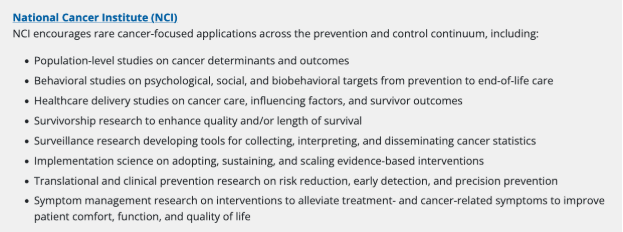
Let’s look at an example. One Highlighted Topic is for Research on Rare Cancers Across the Cancer Control Continuum. There are two participating ICOs: the National Cancer Institute (NCI) and the National Institute for Dental and Craniofacial Research (NIDCR). NCI’s participation describes the specific areas of interest, but does not indicate that funds are dedicated to this topic:
In contrast, NIDCR’s participation does not describe any specific areas of interest beyond the overall Highlighted Topic description, but does indicate that funds could be prioritized for this topic:

What does this mean for you as an applicant? Our overall guidance to applicants remains the same: always reach out to NIH program staff to discuss your intended application or get help identifying and targeting appropriate funding opportunities. You’ll need to submit under a PA, so do identify which NOFO is best suited for your project’s scope. A recent program-specific email indicated that applicants should reference the Highlighted Topic on their specific aims page; this aligns with practices for RFAs and NOSIs. Whenever possible, we suggest pulling in relevant keywords from a funding opportunity description to demonstrate your proposal’s alignment; do the same for the Highlighted Topics. When you do meet with program staff, consider asking questions about what’s being funded under the Highlighted Topic and whether your application complements that portfolio or overlaps too much. If your application is scored during peer review, once you receive the summary statement, reach out to the assigned PO to discuss the next steps for funding consideration.
It’s difficult to say how much these Highlighted Topics will affect funding decisions—the oldest issue date is Aug 2025, so that means we’re just in the period where the first potential applications to Highlighted Topics have been reviewed and are going up for funding decisions. Also, structural and procedural changes often carry a bit of a “working out” period as staff determine where there are issues for staff and/or applicants/awardees (e.g., see the rollout of the Common Forms and NIH Biosketch Supplement). We’ll be watching these and will keep you up to date as we learn more. In the meantime, we’d love to hear from you: have you received guidance from NIH staff about targeting the Highlighted Topics?